
- Teacher: Admin User
Available courses
- Teacher: Dr. Manisha khaire
- Teacher: Admin User
- Teacher: Dr. Manisha khaire
- Teacher: Admin User
- Teacher: DR. GANESH CHAUDHARI
- Teacher: Admin User
- Teacher: DR. GANESH CHAUDHARI
- Teacher: Admin User
- Teacher: DR. GANESH CHAUDHARI
- Teacher: Admin User
- Teacher: DR. GANESH CHAUDHARI
- Teacher: Admin User
- Teacher: Dr. Manisha khaire
- Teacher: Admin User
- Teacher: DR. GANESH CHAUDHARI
- Teacher: Admin User
- Teacher: Prof. Dattatray Manik Fatangade
- Teacher: Admin User
- Teacher: SIDDHARTHA NAVTURE
- Teacher: Admin User
- Teacher: SIDDHARTHA NAVTURE
- Teacher: Admin User
- Teacher: Prof. Dattatray Manik Fatangade
- Teacher: Admin User
- Teacher: SIDDHARTHA NAVTURE
- Teacher: Admin User
- Teacher: SIDDHARTHA NAVTURE
- Teacher: Admin User
- Teacher: Prof. Dattatray Manik Fatangade
- Teacher: Admin User
- Teacher: Dr. S. K. Khandagale
- Teacher: Admin User
- Teacher: Dr. S. K. Khandagale
- Teacher: Admin User
- Teacher: Dr. S. K. Khandagale
- Teacher: Admin User
- Teacher: Dr. S. K. Khandagale
- Teacher: Admin User
- Teacher: Dr. S. K. Khandagale
- Teacher: Admin User
- Teacher: Dr. S. K. Khandagale
- Teacher: Admin User
- Teacher: Dr. S. K. Khandagale
- Teacher: Admin User
- Teacher: Dr. S. K. Khandagale
- Teacher: Admin User
- Teacher: Admin User
- Teacher: DR.Namrata S. Alhat
- Teacher: Admin User
- Teacher: Abhay Patil
- Teacher: Admin User
- Teacher: Dr.Vasudha Shrikrishna Nandanwar
- Teacher: Admin User
- Teacher: PRO.S.S. More
- Teacher: Admin User
- Teacher: Dr. Shiraskar Raju Pralhad
- Teacher: Admin User
- Teacher: Dr. Megha Balkrishna Patole
- Teacher: Admin User
- Teacher: Prof. Dattatray Manik Fatangade
- Teacher: Admin User
- Teacher: Prakash Pangare
- Teacher: Admin User
- Teacher: DR.Namrata S. Alhat
- Teacher: Admin User
- Teacher: DR.Namrata S. Alhat
- Teacher: Admin User
- Teacher: Abhay Patil
- Teacher: Admin User
- Teacher: Dr.Vasudha Shrikrishna Nandanwar
- Teacher: Admin User
- Teacher: PRO.S.S. More
- Teacher: Admin User
- Teacher: Dr. Shiraskar Raju Pralhad
- Teacher: Admin User
- Teacher: Dr. Megha Balkrishna Patole
- Teacher: Admin User
- Teacher: Prof. Dattatray Manik Fatangade
- Teacher: Admin User
- Teacher: DR.Namrata S. Alhat
- Teacher: Admin User
- Teacher: Dr. Megha Balkrishna Patole
- Teacher: Admin User
- Teacher: Prakash Pangare
- Teacher: Admin User
- Teacher: Dr. A. R. Sarange
- Teacher: Admin User
- Teacher: Dr. Megha Balkrishna Patole
- Teacher: Admin User
- Teacher: Prakash Pangare
- Teacher: Admin User
- Teacher: Abhay Patil
- Teacher: Admin User
- Teacher: Prakash Pangare
- Teacher: Admin User
- Teacher: Dr. Megha Balkrishna Patole
- Teacher: Admin User
- Teacher: Prakash Pangare
- Teacher: Admin User
- Teacher: Dr. Shiraskar Raju Pralhad
- Teacher: Admin User
- Teacher: Abhay Patil
- Teacher: Admin User
- Teacher: Dr. A. R. Sarange
- Teacher: Admin User
- Teacher: Dr. Megha Balkrishna Patole
- Teacher: Admin User
- Teacher: Prakash Pangare
- Teacher: Admin User
- Teacher: Admin User
- Teacher: Dr. Megha Balkrishna Patole
- Teacher: Admin User
- Teacher: Abhay Patil
- Teacher: Admin User
- Teacher: Dr. Shiraskar Raju Pralhad
- Teacher: Admin User
- Teacher: Dr. A. R. Sarange
- Teacher: Admin User
- Teacher: Dr. Megha Balkrishna Patole
- Teacher: Admin User
- Teacher: Dr. Megha Balkrishna Patole
- Teacher: Admin User
- Teacher: Abhay Patil
- Teacher: Admin User
- Teacher: Abhay Patil
- Teacher: Admin User
- Teacher: Abhay Patil
- Teacher: Admin User
- Teacher: Prakash Pangare
- Teacher: Admin User
- Teacher: Dr. Megha Balkrishna Patole
- Teacher: Admin User
- Teacher: Prakash Pangare
- Teacher: Admin User
- Teacher: Prakash Pangare
- Teacher: Admin User
- Teacher: Dr. A. R. Sarange
- Teacher: Admin User
- Teacher: Dr. Megha Balkrishna Patole
- Teacher: Admin User
- Teacher: Dr. Megha Balkrishna Patole
- Teacher: Admin User
- Teacher: Dr. Megha Balkrishna Patole
- Teacher: Admin User
- Teacher: Abhay Patil
- Teacher: Admin User
- Teacher: Prakash Pangare
- Teacher: Admin User
- Teacher: Dr.Vasudha Shrikrishna Nandanwar
- Teacher: Admin User
- Teacher: Dr. Shiraskar Raju Pralhad
- Teacher: Admin User
- Teacher: Deep Satav
- Teacher: Admin User
- Teacher: Shruti Nikate
- Teacher: Admin User
- Teacher: Hemant Ubale
- Teacher: Admin User
- Teacher: Vrushali Marne
- Teacher: Admin User
- Teacher: Madhuri Mazire
- Teacher: Admin User
- Teacher: Hemant Ubale
- Teacher: Admin User
- Teacher: Deep Satav
- Teacher: Admin User
- Teacher: Shruti Nikate
- Teacher: Admin User
- Teacher: Madhuri Mazire
- Teacher: Admin User
- Teacher: Vrushali Marne
- Teacher: Admin User
- Teacher: Hemant Ubale
- Teacher: Admin User
- Teacher: Hemant Ubale
- Teacher: Admin User
- Teacher: Deep Satav
- Teacher: Admin User
- Teacher: Vrushali Marne
- Teacher: Admin User
- Teacher: Ms. S. S. Chavan
- Teacher: Admin User
- Teacher: Hemant Ubale
- Teacher: Admin User
- Teacher: Ms. S. S. Chavan
- Teacher: Admin User
- Teacher: Hemant Ubale
- Teacher: Admin User
- Teacher: Akshay Shete
- Teacher: Admin User
- Teacher: Ms. S. S. Chavan
- Teacher: Admin User
- Teacher: Hemant Ubale
- Teacher: Admin User
- Teacher: Ms. S. S. Chavan
- Teacher: Admin User
- Teacher: Hemant Ubale
- Teacher: Admin User
- Teacher: Hemant Ubale
- Teacher: Admin User
- Teacher: Hemant Ubale
- Teacher: Admin User
- Teacher: Ms. S. S. Chavan
- Teacher: Admin User
- Teacher: Vrushali Marne
- Teacher: Admin User
- Teacher: Hemant Ubale
- Teacher: Admin User
- Teacher: Ms. S. S. Chavan
- Teacher: Admin User
- Teacher: Hemant Ubale
- Teacher: Admin User
- Teacher: Hemant Ubale
- Teacher: Admin User
- Teacher: Ms. S. S. Chavan
- Teacher: Admin User
- Teacher: Vrushali Marne
- Teacher: Admin User
- Teacher: Hemant Ubale
- Teacher: Admin User
- Teacher: Hemant Ubale
- Teacher: Admin User
- Teacher: Hemant Ubale
- Teacher: Admin User
- Teacher: Hemant Ubale
- Teacher: Admin User
- Teacher: Smita Lokare
- Teacher: Admin User
- Teacher: Bharat Kangude
- Teacher: Admin User
- Teacher: Smita Lokare
- Teacher: Dr. Mahesh Mahadev Kamble
- Teacher: Admin User
- Teacher: Smita Lokare
- Teacher: Admin User
- Teacher: Dr. Mahesh Mahadev Kamble
- Teacher: Admin User
- Teacher: Smita Lokare
- Teacher: Dr. Mahesh Mahadev Kamble
- Teacher: Admin User
- Teacher: Smita Lokare
- Teacher: Admin User
- Teacher: Dr. Mahesh Mahadev Kamble
- Teacher: Admin User
- Teacher: Smita Lokare
- Teacher: Admin User
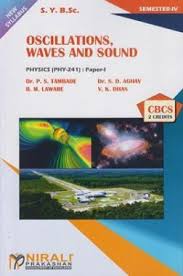
1. Foundational & Mathematical Rigor
The course places a strong emphasis on building a solid mathematical and conceptual foundation. It's not just about definitions, but about deriving and understanding relationships.
Differential Equations: Solving the equation of motion for various oscillatory systems (Simple Harmonic Motion, damped, forced) is central. Students are expected to derive expressions for displacement, velocity, energy, and understand phase relationships.Calculus and Superposition Principle: The treatment of wave motion (especially in the sound section) relies heavily on calculus and the principle of superposition for phenomena like interference, beats, and standing waves.
2. From Simple to Complex Systems
The content is structured to progress logically: Oscillations: Starts with Simple Harmonic Motion (SHM) as the ideal model, then introduces damping (understanding energy decay and logarithmic decrement), and finally forced oscillations & resonance (with sharpness of resonance, Q-factor).
Waves: Moves from the general wave equation to specific applications in sound. The mathematics of traveling and standing waves is emphasized.
Sound: Applies the wave concepts to acoustics, focusing on physical characteristics (intensity, pressure, loudness, pitch) and their measurable relationships (decibel scale, Weber-Fechner law).
3. Phenomenological Understanding with Problem-Solving: The emphasis is on connecting theory to observable phenomena and developing strong problem-solving skills.
Key Phenomena: Deep understanding of resonance, beats, formation of standing waves in air columns and strings, Doppler effect, and acoustic impedance.
Numerical Problem-Solving: A significant portion of exams and learning is dedicated to numerical problems based on:
Time period and frequency of oscillators (simple pendulum, spring-mass, torsional pendulum). Damping parameters.
Wave velocity, frequency, and wavelength relationships. Intensity and sound level (dB) calculations.
Doppler effect in various scenarios.
Stationary waves (harmonics, overtones).
4. Integration of Theory and Practical Application
The course content is designed to directly complement the practical laboratory course. The theory provides the foundation for experiments like:
Determining 'g' using a simple pendulum/compound pendulum.
Studying resonance in air columns (Melde's experiment, sonometer).
Verifying laws of transverse vibrations.
Measuring frequency using beats.
This interplay is a key emphasis, ensuring students can explain their experimental observations theoretically.
5. Core Learning Outcomes (What the University Emphasizes)
By the end of the course, a successful SYBSc Physics student at SPPU should be able to:
Model physical systems (mechanical and acoustic) using the concepts of SHM and wave motion.
Mathematically describe and analyze damped and forced oscillators.
Distinguish between traveling and stationary waves and write their equations.
Solve numerical problems on all major topics, especially resonance, superposition, and the Doppler effect.
Explain the physical basis of sound perception (loudness, pitch) in terms of measurable quantities (intensity, frequency).
Areas of Lesser Emphasis (for clarity):
Highly advanced mathematical techniques (like solving complex partial differential equations for waves in 2D/3D).
Detailed study of ultrasonic waves and their engineering applications (though introduced).
Architectural acoustics or advanced musical acoustics in great depth.
Summary of Emphasis: The SPPU SYBSc Physics course on "Oscillations, Waves and Sound" emphasizes a strong, mathematically-driven understanding of fundamental vibrational and wave phenomena, with a clear pathway to applying this theory to sound and practical laboratory work. The focus is on building a robust foundation for higher studies (MSc) in physics or related engineering fields, with significant weight given to derivations, conceptual clarity, and problem-solving.
Pro-Tip for Students: To excel, concentrate on mastering the derivations, practice a wide variety of numerical problems from recommended textbooks (like the SPPU-aligned ones), and always link your practical lab observations back to the theoretical concepts taught in class.
- Teacher: Bharat Kangude
- Teacher: Admin User
- Teacher: Smita Lokare
- Teacher: Admin User
- Teacher: Smita Lokare
- Teacher: Admin User
- Teacher: Bharat Kangude
- Teacher: Admin User
- Teacher: Dr. Ganesh S. Lonkar
- Teacher: Admin User
- Teacher: Dr. Mahesh Mahadev Kamble
- Teacher: Admin User
- Teacher: Dr. Ganesh S. Lonkar
- Teacher: Admin User
- Teacher: Smita Lokare
- Teacher: Admin User
- Teacher: Bharat Kangude
- Teacher: Admin User
- Teacher: Bharat Kangude
- Teacher: Admin User
- Teacher: Dr. Mahesh Mahadev Kamble
- Teacher: Admin User
- Teacher: Bharat Kangude
- Teacher: Dr. Mahesh Mahadev Kamble
- Teacher: Admin User
- Teacher: Dr. Mahesh Mahadev Kamble
- Teacher: Admin User
- Teacher: Dr. Ganesh S. Lonkar
- Teacher: Admin User
- Teacher: Dr. Mahesh Mahadev Kamble
- Teacher: Admin User
- Teacher: Smita Lokare
- Teacher: Admin User
- Teacher: Dr. Ganesh S. Lonkar
- Teacher: Admin User
- Teacher: Bharat Kangude
- Teacher: Admin User
- Teacher: Dr. Ganesh S. Lonkar
- Teacher: Admin User
- Teacher: Bharat Kangude
- Teacher: Admin User
- Teacher: Bharat Kangude
- Teacher: Admin User
- Teacher: Dr. Mahesh Mahadev Kamble
- Teacher: Admin User
- Teacher: Bharat Kangude
- Teacher: Dr. Mahesh Mahadev Kamble
- Teacher: Admin User
- Teacher: Dr. Mahesh Mahadev Kamble
- Teacher: Admin User
- Teacher: Dr. Ganesh S. Lonkar
- Teacher: Admin User
- Teacher: PRO.S.S. More
- Teacher: Admin User
- Teacher: PRO.S.S. More
- Teacher: Admin User
- Teacher: PRO.S.S. More
- Teacher: Admin User
- Teacher: PRO.S.S. More
- Teacher: Admin User
- Teacher: PRO.S.S. More
- Teacher: Admin User
- Teacher: PRO.S.S. More
- Teacher: Admin User
- Teacher: PRO.S.S. More
- Teacher: Admin User
- Teacher: PRO.S.S. More
- Teacher: Admin User
- Teacher: PRO.S.S. More
- Teacher: Admin User
- Teacher: PRO.S.S. More
- Teacher: Admin User
- Teacher: Prof. V.M. Salve
- Teacher: Admin User
- Teacher: Prof. D.D. Gadge
- Teacher: Admin User
- Teacher: Dr. Rekha R. Joshi
- Teacher: Admin User
- Teacher: DILIP SONAWANE
- Teacher: Admin User
- Teacher: DILIP SONAWANE
- Teacher: Admin User
- Teacher: Dr. Rekha R. Joshi
- Teacher: Admin User
- Teacher: DILIP SONAWANE
- Teacher: Admin User
- Teacher: Prof. D.D. Gadge
- Teacher: Admin User
- Teacher: Dr. Rekha R. Joshi
- Teacher: Admin User
- Teacher: Prof. V.M. Salve
- Teacher: Admin User
- Teacher: Prof. V.M. Salve
- Teacher: Admin User
- Teacher: Prof. D.D. Gadge
- Teacher: Admin User
- Teacher: Dr. Rekha R. Joshi
- Teacher: Admin User
- Teacher: Prof. V.M. Salve
- Teacher: Admin User
- Teacher: Prof. V.M. Salve
- Teacher: Admin User
- Teacher: Prof. D.D. Gadge
- Teacher: Admin User
- Teacher: Prof. V.M. Salve
- Teacher: Admin User
- Teacher: Dr. Rekha R. Joshi
- Teacher: Admin User
- Teacher: DILIP SONAWANE
- Teacher: Admin User
- Teacher: Dr. Rekha R. Joshi
- Teacher: Admin User
- Teacher: Prof. D.D. Gadge
- Teacher: Admin User
- Teacher: DILIP SONAWANE
- Teacher: Admin User
- Teacher: Prof. V.M. Salve
- Teacher: Admin User
- Teacher: Prof. V.M. Salve
- Teacher: Admin User
- Teacher: Dr. Rekha R. Joshi
- Teacher: Admin User
- Teacher: DILIP SONAWANE
- Teacher: Admin User
- Teacher: Dr. Rekha R. Joshi
- Teacher: Admin User